Archive for January, 2011
-
SoCal Code Camp Fullerton
It is time for Code Camp in Fullerton this weekend. I will be speaking on Saturday on this two topics.
- Scrum Roles in Action: in Scrum, there are three basic roles – Team member, Product Owner and ScrumMaster. Each role is defined with some basic specific rights and responsibilities and filling in the rest of what one is supposed to do is left as an exercise for the participants. In this workshop, we will review the rights and responsibilities for the Scrum three roles (plus stakeholders) and discuss what those roles look like when preformed well.
- ScrumMaster Toolkit: are you just getting OK results with Scrum? Has Scrum not delivered on the much anticipated quantum leads in productivity everyone had been promised? One common source of lackluster performance comes from following routine behaviors and ordinary patterns of teamwork associated with the “old way of doing things”. In this hands-on workshop, Carlton Nettleton will share powerful techniques from his coaching toolbox that breaks these old patterns, unlocks the potential of Teams and gets them moving toward high-performance.
-
Scrum Bill of Rights
One of the things I admired about Extreme Programming (XP) was the simplicity of the roles defined in the Green Book. In XP, there are only two roles: Customer and Programmer. When you are using XP, the Customer makes business decisions, Programmers make technical decisions and one role may not substitute their judgement for the other. In short, Programmers do not make business decisions and Customers do not make technical decisions. Kent Beck and Martin Fowler even went so far to add a Bill of Rights, which clarifies what people can expect for one another.
Scrum does not have anything similar, so I decided to create my own (modeled on the XP rights). Feel free to distribute and share.
Every Team member has the following rights:
- To produce quality work at all times.
- To know what is needed from the business with clear declarations of priority.
- To ask for, and receive, help from peers, management, and customers.
- To experiment with new ideas, technologies and roles to grow both as a professional and an individual.
Every Product Owner has the following rights:
- To receive the greatest possible value out of every week.
- To know what can be accomplished by the Team, when and at what cost.
- To see incremental progress in a viable product proven to work by passing acceptance criteria they specify.
- To be informed of schedule changes promptly in order to take effective countermeasures and reset expectations with the stakeholders.
- To collaborate with the business on setting the future direction of the product.
Every ScrumMaster has the following rights:
- To try out different ideas, approaches and techniques to remove impediments which impede the flow of value.
- To be given time for initiatives to take hold and produce change.
- To take measured risks and learn from setbacks.
- To be supported by senior leaders in the organization.
- To be provided access to different parts of the business while identifying and removing impediments.
Every Stakeholder has the following rights:
- To receive regular status updates through interacting with a working product.
- To change their mind, substitute functionality, and adjust priorities without paying exorbitant costs.
- To cancel the product at any time and be left with a working product providing real business value reflecting the investment to date.
-
Combining Scrum Roles
This question started an interesting exchange on the Scrum Development list at yahoo!
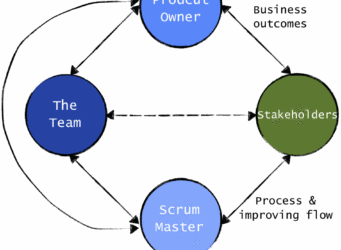
The Scrum Guide states that a person can be “Team Member” and “Scrum Master”, a ”Team Member” and “Product Owner” but emphatically rules out ”Scrum Master” and ”Product Owner” roles by one person. I understand that all these “role combination” lead to one person being split between two set of duties that are required to be performed. But why does only the “SM & PO” combination find particular mention as not acceptable.The way I teach the Scrum roles is that the Product Owner is responsible for the business outcomes and the ScrumMaster is responsible to ensure the process is implemented correctly and improves the flow of value. These responsibilities require very different skill sets and it is rare that all are in one person or that one person wants to learn them all. When the two are combined, one is responsible for doing the work of two people in an 8 hour day – which is then a violation of the Agile principle of sustainable pace.
IMO, I often see people wanting to combine ScrumMaster with Product Owner or as a Team member, i.e. continue as a contributor. As a friend of mine pointed out to me, this desire to combine the roles often speaks to hidden assumption\perception that there really is not enough stuff for a fulltime ScrumMaster. Some people look at the framework and think: “ScrumMaster facilitates some meetings (check), updates Burndown chart (check) and does self-organization (check), not enough here to justify 100% allocation.”
Oh how wrong! Being a ScrumMaster is a full time job. First, one has to help the Team become self-organizing. That is a lot of work, requires close proximity to the Team and many hours of observation. It is not something you can “phone in“. Second, as ScrumMaster you are accountable to the stakeholders to improve the flow of value and help remove the organizational waste, i.e. impediments. A lot of that effort is building relationships with different stakeholders and participating in efforts to remove organizational roadblocks (sometimes called kaizen). You cannot be writing code, doing design or however you contributed in the past, if your responsible for identifying and removing impediments.
-
Scrum Roles Defined
I do a lot of work with Scrum and the ones that struggle the most are the ones where the Scrum roles are poorly defined and\or not filled properly. Scrum is a balanced framework and when the roles get muddled, the framework begins to adopt the dysfunctions of the organization and is not as powerful as it could be.
In Scrum there are three roles – Team member, Product Owner and ScrumMaster. Those three working together are called the Scrum Team (or just the Team). I add a fourth role – Stakeholder – to recognize all the people who orbit a Scrum Team and influence them. I define all these roles like this:
- Team: dedicated collection of self-organizing, interdependent, co-located individuals representing different functional roles with all the necessary skills to turn Product Backlog items into a potentially shippable increment within the Sprint.
- Product Owner: an empowered individual applying their personal and professional judgment to make decisions in the best interest of different,often times competing, business stakeholders to maximize the business value the Team produces each Sprint
- ScrumMaster: a dedicated individual responsible for improving the performance of the Team and the business by any means necessary.
- Stakeholder: any person who has a direct, or indirect, interest in the work of the Team.
Keep in mind, these are role definition, not job descriptions and they are very loosely defined. It is important that each role is filled. In general, the Product Owner is concentrated on the providing valuable business outcomes to the business, while ScrumMaster is aiming his\her efforts at the execution of good Scrum and improving the flow of value to the customer. Meanwhile, the Team remains centered on learning how to self-organize and deliver potentially shippable increments regularly. Stakeholders provide feedback on the value of everyone’s efforts.
When Scrum falters, it is often because people are not committing to their roles. Other times, organizations chose to overload one, or more, roles in a single person, disrupting the balance of the roles. Recall, the Scrum framework was designed to provide the maximum amount of flexibility with the minimum amount of control. If these roles cannot be filled with individuals who will fully inhabit them, or they are overload, the control mechanisms of Scrum become unhinged, visibility is diminished, accountability is lost and the framework loses its meaning.
When Scrum is done well, there exists a natural tension between each role. This tension exerts a force that tends to prevent the other roles from meddling in responsibilities that are not their own. Since there are considerable gray areas on the role boundaries in Scrum, each role will eventually bump into one another as they discover what are the boundaries of their responsibilities. This friction is an essential part of learning how to do Scrum and making it meaningful to your business. Through the of process of inspect-and-adapt, the precise definition of each role – Team member, Product Owner, ScrumMaster and stakeholder – emerges as your organization gains experience using Scrum.One of the main reasons why I add a Stakeholder role to Scrum is because many Scrum implementations improperly keep these people out of the process. Scrum was not designed to keep the Stakeholders from interacting with the Team. In fact, Scrum was designed to bring these folks closer together. What Scrum tries to do is give the Stakeholders a more meaningful, structured way to interact and provide the Team with feedback via the Sprint Review. This is the opportunity for the Team to hear direct, unvarnished feedback on what they really think. This is why Stakeholders have a dashed line connecting themselves with the Team, rather than a solid line.
-
Font Matters
I came across this article today about the importance of font to improve reading comprehension. In the past four months, I have been doing a LOT of instructional design for the variety of classes my business now offers. Much of this work is based on Sharon Bowman’s awesome, awesome book, Training from the Back of the Room, and one of the six trumps that is relevant regarding font selection for class material is below:
Different trumps the same
I have been mixing up fonts in my handouts because I felt if I used a standard font, it would be sightly inconsistent with the classroom experience I am trying to create. In all my classes, I work to create a learning environment where peers are sharing experiences with another and interacting with the material. The variety of fonts on a page were just another manifestation of my training philosophy. Glad to hear it actually helps with retention.
Frequent Topics
Agile Agile SD Certified ScrumMaster Class Design Coaching Collaboration Communication Conferences Daily Scrum Design Excellence Design for Six Sigma Extreme Programming Games Innovation Games Lean Legacy Code Links of the Week Measures Movies Pair Programming Personal Planning PMI Practices Presentations Product Owner Quality Refactoring Retrospectives Rugby Scrum ScrumMaster SIMSOC Spain Team Test-Driven Development Testing Tools Training Transitions Travel Voice of the Customer
Calendar
NetPromoter Score
No progress bars found
Recent Comments
- Kenneth van Rumste on Scrum Roles Defined
- Carlton on Scrum Roles Defined
- Kenneth van Rumste on Scrum Roles Defined
User Groups
Archives
- May 2012 (1)
- April 2012 (2)
- March 2012 (2)
- October 2011 (2)
- August 2011 (1)
- May 2011 (1)
- February 2011 (1)
- January 2011 (5)
- December 2010 (1)
- November 2010 (3)
- October 2010 (6)
- September 2010 (5)
- August 2010 (4)
- July 2010 (6)
- June 2010 (2)
- May 2010 (2)
- April 2010 (5)
- March 2010 (3)
- February 2010 (5)
- January 2010 (7)
- December 2009 (8)
- November 2009 (2)
- October 2009 (6)
- September 2009 (9)
- August 2009 (7)
- July 2009 (4)
- June 2009 (3)
- May 2009 (3)
- April 2009 (5)
- March 2009 (6)
- February 2009 (6)
- January 2009 (7)
- December 2008 (10)
- November 2008 (11)
- October 2008 (10)
- September 2008 (4)
- August 2008 (5)
- July 2008 (5)
- June 2008 (8)
- May 2008 (5)
- April 2008 (3)